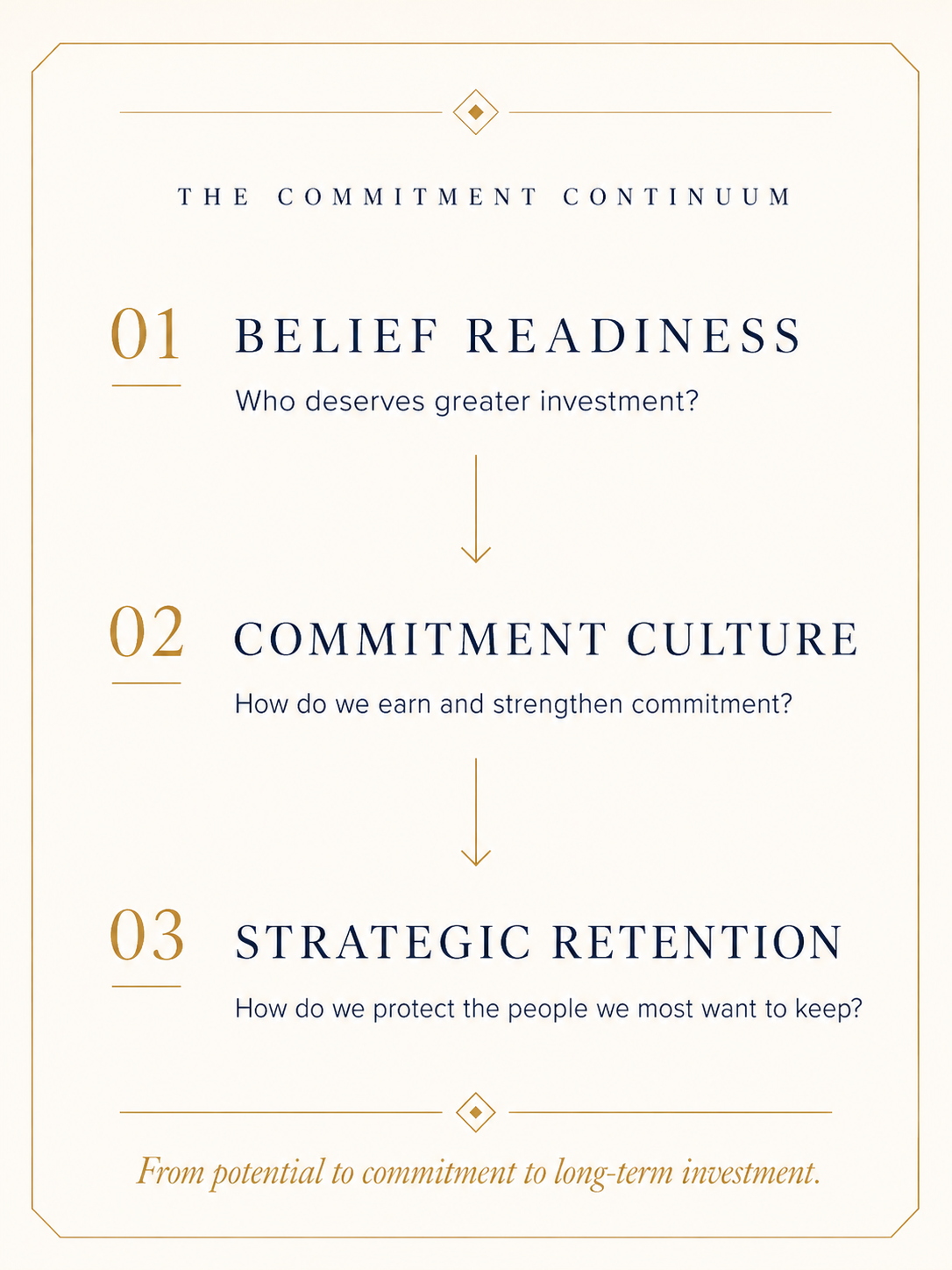
STRATEGIC RETENTION
____________
Protect the people you cannot afford to lose.
Belief Before Proof® helps leaders identify the right people, create the conditions that earn their commitment, and build cultures they want to remain part of.
But some people become too important to protect with culture alone.
For those individuals, organizations may need a long-term retention strategy as intentional as the leadership investment that made them valuable in the first place.
Identify wisely · Build commitment · Protect what matters
THE RETENTION CHALLENGE
____________
Compensation can attract great people. It does not always give them a reason to stay.
Most organizations already invest significantly in their most important people through salary, bonuses, benefits, retirement plans, equity, opportunity, and recognition.
Those investments matter. But as responsibility grows, the people carrying the greatest weight can also face increasingly complex personal and financial pressures—and traditional compensation may not address all of them.
The question is no longer simply, “Are we paying this person competitively?”
The better question is, “What are we doing to protect the relationship with someone we would genuinely prefer not to lose?”
01 — Protection Today
Family and financial protection during the years when responsibility may be highest.
____________________
02 — Financial Flexibility
Greater access to capital and optionality during demanding career and life stages.
____________________
03 — Security Tomorrow
A long-term financial strategy capable of extending beyond traditional compensation and retirement programs.
____________________
The challenge is not always compensation. Sometimes the challenge is alignment.
THE STRATEGIC RETENTION RESPONSE
____________
The strongest retention strategies reinforce both commitment and long-term security.
The goal is not simply to pay people more. The goal is to create a stronger reason for the right people to remain aligned with the organization they help lead.
For some individuals, that may require a retention strategy that goes beyond salary, bonuses, and traditional benefits—one that strengthens loyalty, creates meaningful long-term value, and helps protect the future of the people the organization most wants to keep.
When designed properly, retention strategy becomes more than compensation. It becomes a visible expression of belief, trust, and long-term commitment.
01 — Reward Long-Term Alignment
Create value that deepens over time rather than disappearing after a single compensation cycle.
The most effective retention tools reward continuity, stability, and long-term contribution—not just short-term performance.
____________________
02 — Support Real-Life Financial Needs
Help key people protect their families, strengthen their financial position, and gain greater flexibility.
Retention becomes more meaningful when it addresses real personal needs, not just professional incentives.
___________________
03 — Protect What the Organization Has Built
Retain the leaders, high performers, and culture carriers who are hardest to replace.
Replacing important people is costly—in continuity, trust, performance, and institutional momentum.
____________________
Retention is strongest when the organization’s investment feels both valuable and personal.
A PRACTICAL RETENTION PLATFORM
____________
What if an organization could make a meaningful long-term investment in key people while preserving greater financial flexibility?
Traditional retention strategies usually require an organization to choose where additional dollars will be spent—more compensation, larger bonuses, enhanced benefits, or another conventional incentive.
For qualifying organizations and individuals, there may be another approach.
Through a strategic relationship with Cool Springs Financial, Daron can help organizations explore Dynamic Life™—a customized retention strategy designed to combine meaningful long-term value for important people with a more efficient approach to organizational capital.
01 — Protect Capital
Preserve greater organizational liquidity while exploring meaningful long-term benefits for key people.
The strategy is designed to consider both the value being created for the individual and the organization's need to deploy capital responsibly.
____________________
02 — Protect People
Create meaningful family protection for individuals carrying significant responsibility.
Long-term retention becomes more powerful when the investment also addresses something deeply personal to the individual and the people who depend on them.
____________________
03 — Create Financial Flexibility
Add another dimension of personal financial optionality beyond salary and traditional benefits.
Depending on the structure, the strategy can incorporate access to capital and long-term financial value as part of the retention conversation.
____________________
04 — Strengthen Retention
Give important people another reason to connect their future to the organization.
When structured appropriately, long-term financial investment can become tangible evidence that the organization sees the relationship differently.
____________________
This is not about replacing compensation. It is about extending the organization’s investment beyond compensation.
Capital efficiency · Personal value · Long-term alignment
DYNAMIC LIFE™
Powered by Golden Street and offered exclusively through Cool Springs Financial.
Dynamic Life™ combines permanent life insurance, structured capital, and customized financial design as part of a broader long-term strategy. Every opportunity is evaluated individually and is subject to financial suitability, underwriting, lending approval, structure, and professional review.
THE CAPITAL INNOVATION
____________
A different approach to funding long-term value.
Traditional retention benefits typically require an organization to commit additional current cash, tie up capital, or accept another recurring expense.
Certain Dynamic Life™ structures are designed to approach the problem differently—using outside capital and structured financing to help create long-term benefits while preserving greater organizational flexibility.
The objective is not simply to spend more on retention. It is to use capital more intelligently.
01 — Preserve Liquidity
Keep more organizational capital available for the business, institution, or mission.
The structure is designed to reduce dependence on large current cash outlays when qualifying circumstances allow.
____________________
02 — Use Structured Capital
Explore financing designed specifically around long-term insurance and retention objectives.
The strategy may incorporate third-party lending, collateral design, and customized financial architecture based on the organization and individual.
____________________
03 — Build Long-Term Value
Create a benefit designed to become increasingly meaningful over time.
The focus is long-term alignment, protection, optionality, and retention—not a short-term compensation event.
____________________
FRICTION-FREE FINANCING
A financing approach designed to reduce the traditional friction between protecting important people and preserving organizational capital.
In qualifying structures, Cool Springs Financial may be able to arrange financing that reduces traditional collateral or asset-lockup requirements while maintaining the organization’s ability to pursue a meaningful long-term retention strategy.
Protect people · Preserve flexibility · Strengthen long-term alignment
WHO THIS CAN WORK FOR
____________
Different organizations. The same retention question: Who can we least afford to lose?
The structure will never be identical from one organization or individual to another. Financial objectives, governance, underwriting, lending, timing, and personal priorities all matter.
But the strategic question is remarkably consistent:
Who is important enough that losing them would materially affect the organization—and is there a responsible way to make a greater long-term investment in that relationship?
01 — Companies & Executive Teams
For founders, senior executives, high performers, and culture carriers whose continuity materially matters to the organization.
A retention strategy may help organizations strengthen long-term alignment without relying exclusively on increased current salary, bonuses, or conventional benefits.
____________________
Best suited for:
Leadership continuity · Key-person retention · Succession · Long-term alignment
02 — Colleges, Universities & Athletic Leadership
For institutions seeking to protect important human capital while preserving responsible stewardship of institutional resources.
Presidents, senior administrators, academic leaders, coaches, and other critical personnel can represent significant institutional value that may be difficult and expensive to replace.
____________________
Best suited for:
Leadership continuity · Key personnel · Institutional stability · Long-term stewardship
03 — Business Owners & Senior Executives
For qualifying individuals who may benefit from a more strategic approach to protection, liquidity, legacy, and long-term financial optionality.
In appropriate circumstances, the same capital principles used in organizational strategies can also be evaluated around an individual’s personal financial objectives.
____________________
Best suited for:
Protection · Liquidity · Legacy · Long-term optionality
The category does not determine the fit. The person, the objective, and the economics do.
Understand the need · Evaluate the fit · Structure responsibly
A DISCIPLINED PROCESS
____________
01 — Identify the Person
Who matters enough to warrant a greater investment?
Begin with the individual whose continuity, contribution, or long-term relationship materially matters.
____________________
02 — Understand the Objective
What are the organization and individual actually trying to accomplish?
Clarify the retention, protection, liquidity, continuity, or long-term planning objective before considering structure.
____________________
03 — Evaluate the Economics
Does the structure make financial sense?
Underwriting, financing, capital requirements, projected performance, and long-term assumptions must support a responsible strategy.
____________________
Identify carefully · Evaluate objectively · Structure responsibly
04 — Review Before Action
Implementation follows diligence—not enthusiasm.
Appropriate legal, tax, financial, governance, insurance, and lending review occurs before a strategy moves forward.
____________________
We do not begin with a product. We begin by determining whether there is a legitimate problem and a responsible fit.
Every potential strategy is evaluated around the person, the objective, the economics, and the professional review required before implementation.
START WITH ONE PERSON
____________
You do not need to redesign your entire benefits program to begin. Start with one person you would genuinely prefer not to lose.
The first conversation is not about buying a product or committing to a structure. It is about understanding the person, the retention challenge, and whether a responsible strategy is worth exploring.
If the fit is not there, we stop. If it is, the appropriate financial, insurance, lending, legal, tax, and governance professionals can evaluate the opportunity in greater detail.
Financial and insurance strategies are subject to individual suitability review, underwriting, lending approval, costs, financing terms, and appropriate professional review. Outcomes are not guaranteed.